The Cobbler's Cycle
Spec by day, elves by night. My 24-hour production cycle.


Designers and developers are going to bed with half-finished work and waking up to find it done. Not by junior colleagues burning the midnight oil. Not by offshore teams in a different timezone. By AI agents, running autonomously through the small hours, turning specifications into shipping code.
I want to propose a name for this: The Cobbler’s Cycle.
The Tale
In the Brothers Grimm’s “The Elves and the Shoemaker“ a cobbler has fallen on hard times. He has just enough leather for one final pair of shoes. One evening he cuts the leather to shape, lays the pieces on his workbench, and goes to bed. He has done what he can. The rest is out of his hands.
In the morning, the shoes are finished. Perfectly stitched, not a stitch out of place. A customer arrives, admires the craftsmanship, and pays a premium. The cobbler buys leather for two more pairs. He cuts them out that evening, goes to bed, and wakes again to find them done. The pattern continues. What he prepares in the evening is completed by daybreak. The cobbler becomes prosperous.
One Christmas Eve, the cobbler and his wife decide to stay up and watch. At midnight, two small naked figures appear, sit at the workbench, and stitch with extraordinary speed and skill. By morning they are gone. The wife, moved by gratitude, sews tiny shirts and trousers. The cobbler makes them each a pair of shoes. They leave the clothes on the workbench instead of leather. The elves arrive, find the gifts, put them on with delight, dance around the room, and leave forever.
The cobbler never sees them again. But he prospers for the rest of his life.
The Cycle
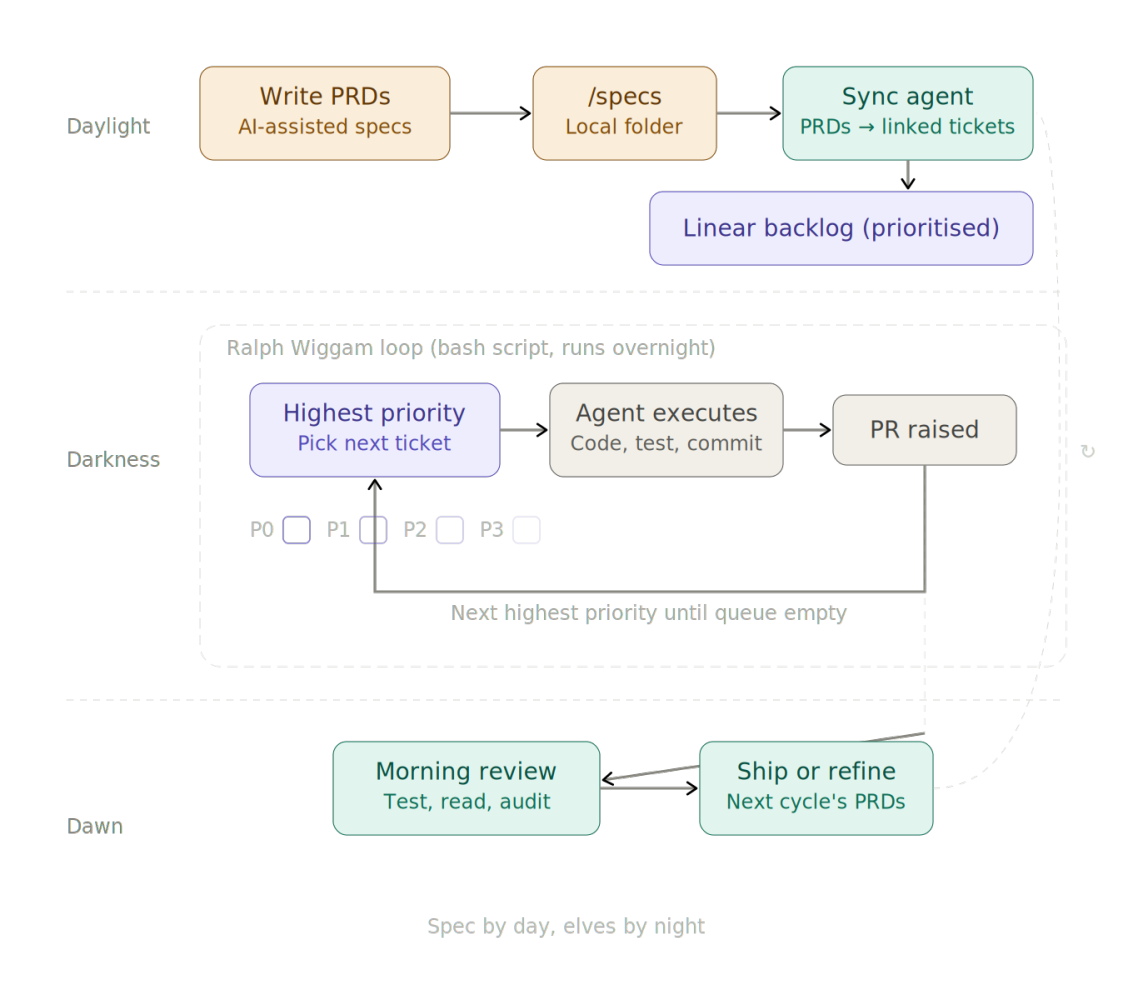
The Cobbler’s Cycle is a 24-hour creative production loop built around AI agents. It has three phases.
Phase One: Daylight (the human work)
This is where the thinking happens. You define the problem. You write the spec. You make the architectural decisions, choose the approach, set the constraints. You do the work that requires taste, context, judgement, and an understanding of the people you are building for. You cut the leather to shape - AI-assisted PRDs in a local specs folder - and a sync agent reads them and lays them on the workbench as linked, prioritised tickets in Linear. Then you go to bed.
Phase Two: Darkness (the elves’ work)
A bash script coined ‘The Ralph Wiggam loop’ picks the highest-priority ticket from the Linear backlog and hands it to an agent. The agent reads the PRD, writes the code, runs the tests, commits, and raises a PR. The script picks the next ticket. It repeats, cheerfully and relentlessly, until the backlog is empty by morning. If you have seen the meme, that is the energy: unselfconscious, undeterred. The elves work through the night, following the patterns you laid out on the bench. They do not improvise. They do not redesign. They execute the plan with diligence and surprising competence.
Phase Three: Dawn (the review)
You wake up. You review, test, refine, course-correct. The work is not always perfect. But the bulk of the labour is done. The structural work, the repetitive implementation, the boilerplate that eats hours. You are left with the interesting problems, the ones that require a human eye and a human decision.
Then the cycle begins again. Spec by day, elves by night.
Why This Metaphor Matters
We could call this “asynchronous agentic development” or “overnight CI/CD.” But clinical language hides what is actually a profound shift in creative practice. The cobbler’s tale captures truths that engineering language does not.
The compact is fragile. The elves work best when the cobbler prepares the leather clearly and then steps away. Over-specify and you constrain them into brittle implementations. Under-specify and you get chaos. In practice this means a well-structured repo with established patterns, a PRD that includes not just what to build but why, and test criteria defined before you close the laptop. Not too much, not too little.
You must not try to make them human. The cobbler’s wife sewed the elves tiny clothes out of kindness. They put them on with delight, danced, and left forever. The gift was generous but it ended the working relationship. Yes, this entire article is an extended anthropomorphism. But there is a difference between a metaphor that helps you think about a working relationship and the mistake of treating the agent as if it has preferences. The cobbler never asked the elves what they wanted. He prepared the leather and stepped away. Anthropomorphising AI agents, treating them as junior developers, giving them “feedback” as if they have feelings, is the surest way to break the compact.
Gratitude, not payment. Across every version of this folklore, the offering must be a gesture of gratitude, never a transaction. The moment it becomes payment, the spirit departs. The best AI workflows feel similar. The cost of the compute is trivial compared to what you get back. The relationship is not transactional in the way hiring a contractor is. It is something stranger and newer, empowering in a way that does not fit old economic frames. This is perhaps the most underexplored aspect of the shift. We do not yet have the language for a working relationship where one party requires no salary, no management, no motivation, and no recognition. That does not mean the ethical questions disappear. It means the old frameworks do not map cleanly onto what is happening here.
The work exists in a liminal space. You did the thinking. They did the making. The cobbler and the elves both deserve credit for the shoes. The interesting question is not who made it, but whether it is good and fit for purpose.
When the elves turn trickster. In Irish folklore, the closest cousin is the puca, a shapeshifting spirit that might give you wise counsel one night and take you on a terrifying midnight ride the next. The agentic equivalent is real. Badly configured agents with poor specs and no human review will generate technical debt at superhuman speed. They will build the wrong thing with total confidence, compounding errors through the night until dawn reveals a codebase that is structurally unsound. If you skip the thinking and go straight to the agents, you have not prepared the leather. You have left an empty workbench.
Running a Cobbler’s Cycle
I have been running Cobbler’s Cycles at Sinjin Studio for the past few months, building MCP-backed intelligent business layers for artisan, small business clients. Here is what I have learned.
The spec is everything. I spend the creative hours of the day writing detailed specifications: what to build, why, what success looks like, and the test criteria the agents run against before committing. The discipline is in delaying the reward, building up enough well-defined work for the elves overnight rather than starting to implement yourself. You are making best use of your waking hours this way. You do not have to set them to work every night. With the abundance of code they offer, there is a tendency to overproduce features. Complexity is easy. Keeping it simple is hard and needs effort and care.
The review is non-negotiable. Every morning starts with a thorough audit of what was built overnight. I test. I read the code. I check the architectural decisions against the spec. The elves are competent but literal. They will follow your patterns even when your patterns were wrong. Due to my own poor wording that had multiple meanings, I have had to throw away entire night’s work. My fault. You learn. You hone. You think carefully about the context you are setting.
The rhythm becomes addictive. There is something deeply satisfying about ending a working day by writing the plan for what happens next, going to sleep, and waking up to find progress. It changes your relationship with time. A solo practitioner can produce work at a pace that was previously impossible, tackling concepts and experiences at the edges of their capacity or beyond.
You have to let go. The hardest part of the Cobbler’s Cycle is the same thing that makes the fairy tale so potent: you have to trust the process and not interfere. Write the spec, prepare the leather, close the laptop. Do not sit up watching the agents work. The cobbler prospered for years before he stayed up to watch. The watching was the beginning of the end. This is not an argument against oversight. The morning review is the oversight. It is an argument against hovering, against the compulsion to watch each line of code appear in real time, which breaks the rhythm and defeats the purpose.
Cut the Leather
The elves are not servants. They are not employees. They are not tools, exactly. They are something older and stranger, skilled spirits that have appeared at your workbench and will produce astonishing work for as long as you respect the compact.
Prepare the materials. Define the task. Step away.
Just cut the leather. Lay it on the bench. Go to sleep. Wake up to finished shoes.
Spec by day, elves by night. The Cobbler’s Cycle.
Paddy Keane is the founder of Sinjin Studio , an independent creative technology practice shipping AI-native web experiences. He has 25 years of experience in creative technology, including 15 years as Creative R&D Director at AKQA London.